The LatticeworkA Mental-Models Reading · July 2026
Tap edges or swipe ← →
Field Note · Physics & Epistemology
The Cat That Breaks the Map.
Schrödinger designed his thought experiment as a reductio ad absurdum against quantum mechanics. Ninety years later, it remains the field's most effective teaching tool — and a powerful perturbation for the latticework.
Source Veritasium · July 2026Subject Derek MullerLens fs.blog/mental-models
1 / 7
Veritasium · What happens to Schrödinger's cat? · July 2026
1935Year of the thought experiment
2Superposed states
0Literal cats intended
∞Interpretations proposed
2 / 7
I · The Frame
Why a thought experiment about a cat matters for the latticework.
Erwin Schrödinger was annoyed. In 1935 he wrote up his cat scenario not as an illustration of quantum mechanics but as an indictment of it. His argument was essentially: if your theory implies a cat is simultaneously alive and dead, your theory is wrong. The remarkable thing is that physics declined to take the hint. The cat-in-a-box picture became the canonical explainer for quantum superposition — the very phenomenon Schrödinger intended it to embarrass.
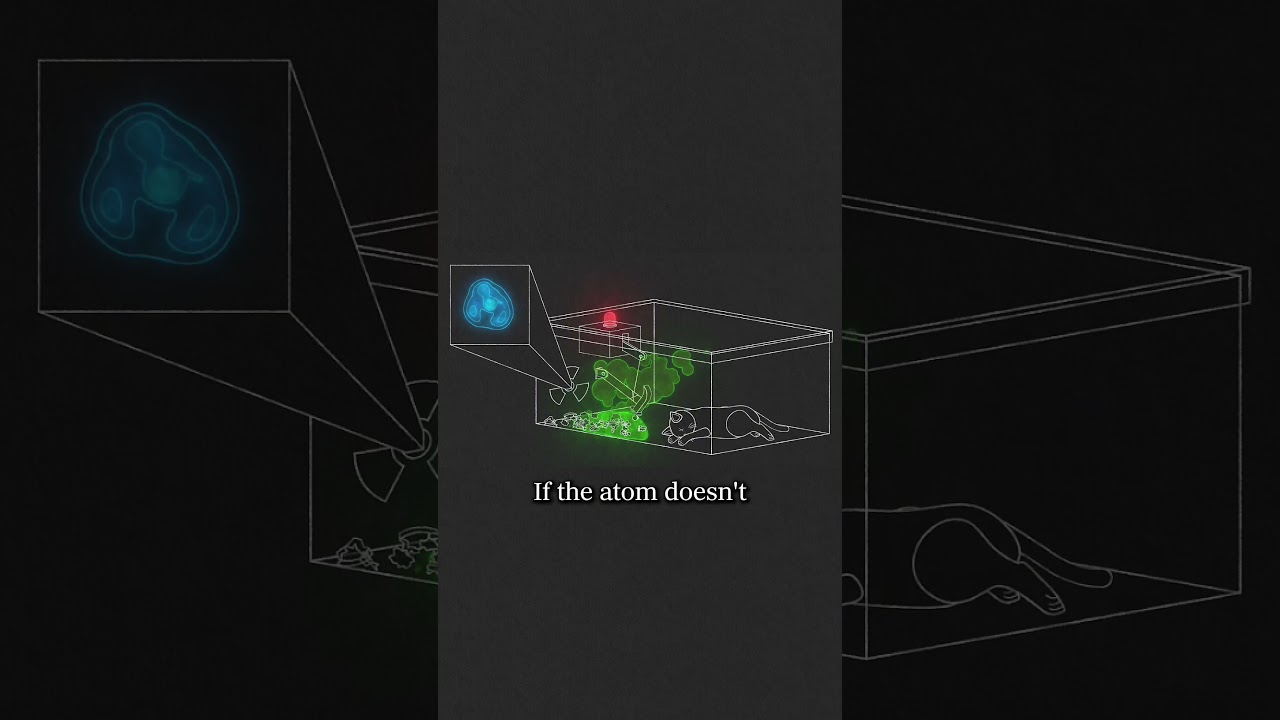
Derek Muller's Veritasium treatment walks through the logic cleanly in under two minutes. An atom in a superposition of decayed and not-decayed. A detector entangled with the atom. A poison mechanism entangled with the detector. A cat entangled with all of the above. Once the box is sealed, the wave function of the whole system — atom, detector, poison, cat — is in superposition. Only measurement collapses it to one of two definite outcomes.
The latticework implications are not trivial. Three classic models come out amplified. Two get seriously bent. And at least three models worth adding appear, with surprising applicability beyond physics — in management, decision-making, and epistemology.
3 / 7
II · The Reinforced
Old models, quantum-hardened.
The first model the video amplifies is first principles thinking. Schrödinger's cat is a perfect case study in how first-principles reasoning leads somewhere profoundly counterintuitive but verifiably real. Quantum mechanics is not "wrong because it gives weird results." The weird results are what the mathematics mandates, and every experiment since 1935 has confirmed them. The lesson generalises: if your first principles are right and your reasoning is correct, you follow the conclusion even when it offends intuition. The cat is an existence proof that intuition-violation is not a falsification criterion.
Put a cat in a box with a radioactive atom. Add a radiation detector that triggers the release of poisonous cyanide gas. Schrödinger's device must be secured against direct interference by the cat…
Put a cat in a box with a radioactive atom. Add a radiation detector that triggers the release of poisonous cyanide gas. Now, although it was only meant as a thought experiment, Schrödinger helpfully notes this device must be secured against direct interference by the cat. Anyway, the whole point of the experiment is to magnify the state of the atom up to the state of something macroscopic and tangible. He could have picked anything. It didn't have to be alive, but Schrödinger selected a cat. If the atom decays, the detector detects radiation, releases the poison, and the cat dies. If the atom doesn't decay, the detector doesn't detect radiation, poison is not released, and the cat remains alive. Since the state of the cat and detector apparatus are directly tied to the state of the atom, we say they are entangled.
The second model amplified is the map is not the territory. Alfred Korzybski's insight — that our representations of reality are not reality itself — gets a quantum-physics edge here. The wave function is not the cat; it is a probability amplitude, a mathematical map of what the cat's state might be when measured. Before measurement, the map holds multiple states simultaneously. The cat's territory, however, does not exist in any definite form until the map gets consulted. Korzybski's original point was about descriptive lag; quantum mechanics reveals something stronger: in some domains, the map genuinely precedes the territory.
Systems thinking — the discipline of seeing interacting parts as a whole rather than isolating them — finds its clearest physical example in entanglement. The atom, the detector, the poison mechanism, and the cat are not independent entities that happen to be near each other. They are one entangled system. You cannot say "the atom is in state X" without simultaneously specifying what that means for every entangled element. This is what systems thinkers mean when they say a system is more than the sum of its parts: the whole has properties that don't exist at the level of the individual components.
Where things get weird: the atom does not have to be either decayed or not decayed — it's in a superposition of both at the same time…
Where things get weird is that according to quantum mechanics, the state of the atom does not have to be either decayed or not decayed. Generally, it's in a superposition of both, decayed and not decayed at the same time, assuming no measurements have been made. This superposition state of the atom gets entangled with the detector and then the cat. So, after some time, the wave function of everything inside the box is in a superposition of the atom has not decayed, poison not released, cat alive state and the atom has decayed, poison released, cat dead state.
4 / 7
III · The Contradicted
Models that do not survive intact.
The hardest hit is binary thinking — the law of excluded middle in classical logic: every proposition is either true or false; there is no third option. The cat is either alive or dead. Classical logic says so. Schrödinger's equation says otherwise. In quantum systems, prior to measurement, the proposition "the cat is alive" is neither true nor false; the cat is in a superposition of states that contains both. This is not a failure of our knowledge (we just don't know which); it is a feature of the physics (neither state is definite). Binary thinking works at macroscopic scales but is a wrong model at quantum ones. The lesson for the latticework: know which scale you're operating at before applying the classical logic toolkit.
So, according to quantum mechanics, the cat really is both alive and dead at the same time. Only when we open the box and make a measurement does the wave function collapse…
So, according to quantum mechanics, the cat really is both alive and dead at the same time. Only when we open the box and make a measurement does the wave function collapse and the cat actually becomes either dead or alive.
The second overturned model is classical determinism. The view that every event is in principle predictable from prior causes — that uncertainty is always epistemic, never ontological — collides with quantum mechanics directly. The atom's decay is not merely unknown; according to the standard interpretation, it is genuinely undetermined until observed. There is no hidden variable that, if we knew it, would tell us when the decay would happen. Uncertainty is built into the fabric of the system, not a gap in our measurements. Determinism, as a mental model, holds in classical domains and breaks in quantum ones. Recognising which regime you're in matters.
The subtler contradiction touches observer neutrality — the assumption that an observer can watch a system without changing it. Measurement in quantum mechanics is not passive. Opening the box and looking collapses the wave function; the act of observing is the act of determining. This has a real analogue beyond physics: any time measurement forces a system to commit to a state (employee performance reviews that change what employees do, surveys that shift opinions, data collection that modifies behavior), the observer-neutrality assumption breaks. Schrödinger's cat is physics' way of making this visible.
5 / 7
IV · The New
New entries for the latticework.
The most portable new model is Superposition as Epistemic State. Quantum mechanics teaches that some systems genuinely don't have a resolved state until forced to one. Transplant this into management and decision-making: there are situations where the right move is to leave the question genuinely unresolved — not to delay a decision out of cowardice, but to preserve the optionality that exists in a superposed state. A startup with two viable business models is not confused; it is in superposition. Forcing premature collapse (committing to one model before market evidence arrives) destroys the value of that superposition. The model doesn't say "never decide." It says "distinguish unresolved-by-design from unresolved-by-avoidance."
The second new model is the Measurement Collapse Effect: aggressive measurement of a system tends to collapse it into the behavior being measured, destroying adjacent behaviors. A company that measures only revenue conversion rates will find that its team optimises for conversion — sometimes at the cost of customer lifetime value, which doesn't collapse into the measurement. An organisation tracking only quarterly KPIs will find that teams optimise for quarter-end, not for durable performance. Schrödinger's cat is the extreme version: measurement determines outcome. The everyday version is milder but equally real.
The third is what we might call the Scale Trap: mental models valid at one scale routinely fail when applied at another. Binary thinking works at macro scales (the cat is dead or alive when you observe it). It fails at quantum scales. Classical determinism works at human timescales and human-sized objects. It fails for atoms. Most multi-scale errors in analysis — applying individual-level models to populations, applying macro-economic models to firms, applying firm-level intuitions to markets — are Scale Trap failures. Schrödinger's experiment is physics' gift: a concrete, visual example of what happens when you try to run a macro model in a micro domain.
6 / 7
V · The Field Card
When to reach for which.
VI · Coda
The latticework, after the cat.
What quantum mechanics contributes to the latticework is not really physics — it's a set of hard-won lessons about the limits of classical intuition, and they turn out to have analogues wherever the usual assumptions of scale, independence, and observer-neutrality break down.
The cat really is both alive and dead at the same time. Only when we open the box and make a measurement does the wave function collapse. Veritasium · July 2026
The lasting gift of Schrödinger's cat is not the answer to whether the cat is alive. It is the question it forces: what does it mean for a state to be real before it is observed? That question, translated out of physics, becomes one of the most practically useful questions in management, decision-making, and epistemology. Some things only become real when you look.