Field Note · Ecology & First Principles
Life without the sun.
A latticework reading of Veritasium's cave ecosystem — which assumptions about energy, competition, and abundance the spiderweb overturns, and what new models it deposits.
A latticework reading of Veritasium's cave ecosystem — which assumptions about energy, competition, and abundance the spiderweb overturns, and what new models it deposits.
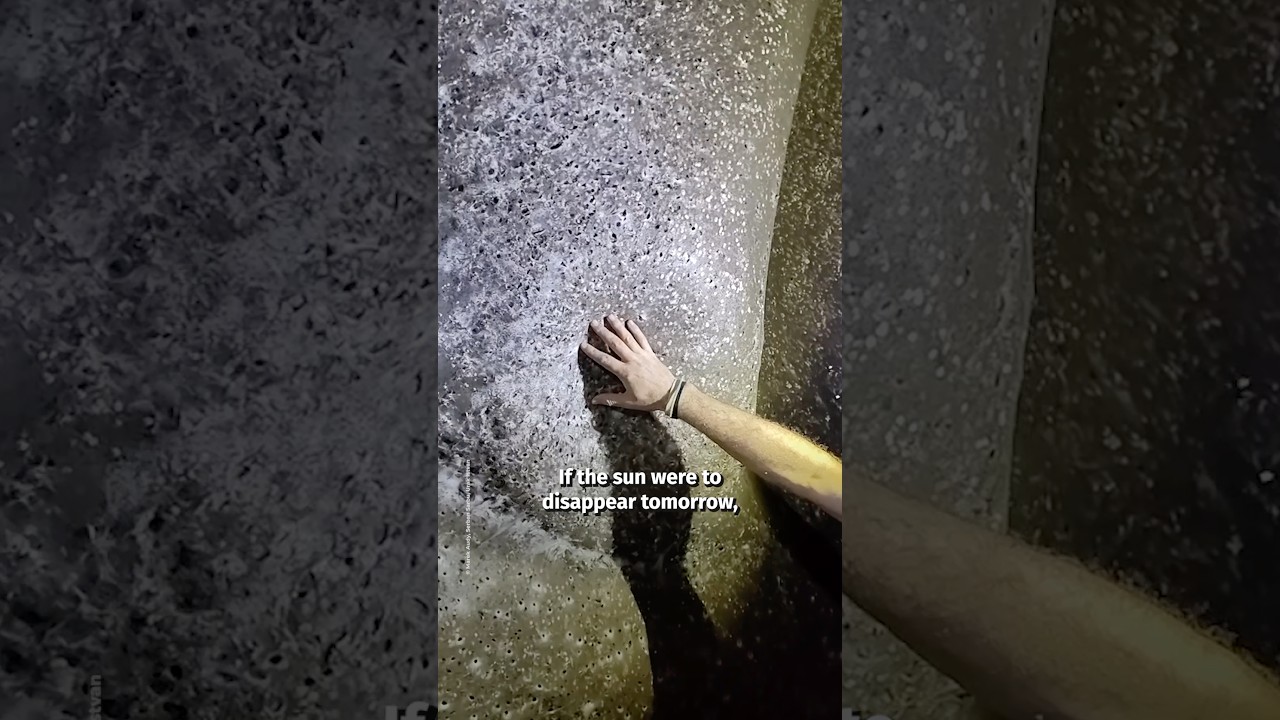
Veritasium — The world's largest spiderweb, sustained entirely by sulfur
On the border of Greece and Albania, there is a cave. Wade through chest-high water for fifty metres, and you find a thick, spongy substance covering one hundred square metres of rock — one hundred thousand spiders, the world's largest web. The cave has no sunlight. No photosynthesis. No plants. And yet it is teeming. Derek Muller's ninety seconds do not explain an anomaly; they dismantle an axiom.
The axiom is this: all complex life ultimately depends on the sun. We learned it so early and so completely that it became invisible, the kind of assumption that does not need stating. Photosynthesis converts sunlight into the sugars that power plants, which power herbivores, which power carnivores. Everything feeds upward from that solar foundation. The latticework holds this model as bedrock.
The cave proves the bedrock is a special case, not a universal law. Life does not need the sun. It needs energy. Sulfur is energy. Bacteria that eat sulfur compounds in rock are doing what plants do with light: converting a raw energy source into biomass that propagates up a food chain. The chain is different, but the logic is identical. The model needs updating.
Emergence — the idea that complex adaptive systems arise from simple local rules without central direction — gets a vivid illustration here. No one designed this ecosystem. Sulfur bacteria colonised the rock because the chemical gradient was there. Cave flies found the bacteria. Spiders found the flies. A predator-prey pair that would normally eat each other discovered that cooperation (or rather, tolerance in abundance) was more efficient. The hundred-thousand-spider supercolony is the output of local interactions, iterated. No blueprint, no planner.
Ecological niches also become sharper here. The cave is not a compromise environment where generalists survive at reduced capacity. It is an extreme environment where specialists thrive precisely because their niche has no competition from sun-dependent life. The same logic applies to markets, organisations, and technologies: a sufficiently specialised niche, left uncontested, can sustain extraordinary density.
And abundance changes behaviour — one of the cleanest illustrations of this principle available. The larger spider normally eats the smaller one. In this cave, with millions of cave flies creating what the narrator calls a "near-infinite buffet," the larger spider stopped. Not because of altruism, not because of negotiation, but because the caloric calculus changed. Surplus resources dissolved a competition that had persisted for evolutionary time. That is the model in motion.
The most fundamental model that fails here is photosynthesis as the root of all complex life. This is not a minor adjustment; it is a root-node correction. The cave ecosystem runs on chemosynthesis — bacteria oxidising inorganic sulfur compounds rather than harvesting photons. The energy accounting works identically; the source is unrecognisable. Any model that assumes "primary producer = photosynthetic organism" is now a special case of a more general model: "primary producer = organism that captures free energy from a chemical or photon gradient."
The predator-prey dynamic also gets bent. Standard game-theory models of predation assume the predator has incentive to hunt the weakest available prey, including members of a competing but smaller species. In this cave, that prediction fails. When prey density is high enough, the cost-benefit of inter-species conflict inverts. The predator and nominal prey converge on a non-aggression equilibrium — not because their interests aligned, but because their incentives did. The model generalises: scarcity produces conflict; abundance can dissolve it without negotiation.
Finally, the intuition that dark, sunless environments are lifeless or impoverished fails completely. The cave is not impoverished; it is extraordinarily dense. The absence of sunlight is not a deficit — it is a filter that removes all the surface competition, leaving the field to the sulfur specialists. This matters for any domain where a hostile operating environment is treated as a disqualifier rather than a moat.
The cave gives the latticework at least three new model entries. The first is chemosynthetic foundation — the generalised version of the photosynthesis model. In any complex system, look for the primary energy converter: the agent that takes a raw gradient (chemical, thermal, photonic, informational) and converts it into a form that propagates up the system. Photosynthesis is one instance. Sulfur bacteria are another. In a software organisation, this might be the engineers who convert raw user problems into working abstractions. In a financial system, the market makers. Identify the converter; you have identified the system's power source.
The second is abundance peace — a corollary to the scarcity-conflict model. When a resource becomes abundant enough relative to demand, competitive dynamics that were structurally stable under scarcity dissolve without coordination. This is not the same as cooperation: the spiders did not agree to stop fighting. The incentive structure changed. The model predicts when rivalries will soften without negotiation: supply the resource, and the conflict follows.
The third new model is what might be called hostile-environment moat — the principle that an operating environment too hostile for generalists becomes an exclusive niche for specialists, producing extraordinary density and zero surface competition. The cave keeps every sun-dependent organism out. That exclusion is not a bug; it is the foundation of a monopoly. Wherever a domain looks uninhabitable from the outside, ask what specialists might already be thriving in it.
The cave at the Greek-Albanian border is a perturbation of the most stable fact in biology. It does not disprove the sun's importance; it shows that the sun's importance was never intrinsic — it was contingent on which energy gradient happened to be available. That is a clean lesson in first-principles thinking: strip back the axiom, find the actual load-bearing variable, and discover that the "universal" law was local all along.
Here is this fully self-sustained ecosystem that's not powered by the sun, but based on sulfur. — Veritasium