Field Note · Space & Infrastructure
Orbital compute.
A latticework reading of Y Combinator's call for electronics in space — which models of constraint and opportunity hold, which break, and which ones to add.
A latticework reading of Y Combinator's call for electronics in space — which models of constraint and opportunity hold, which break, and which ones to add.
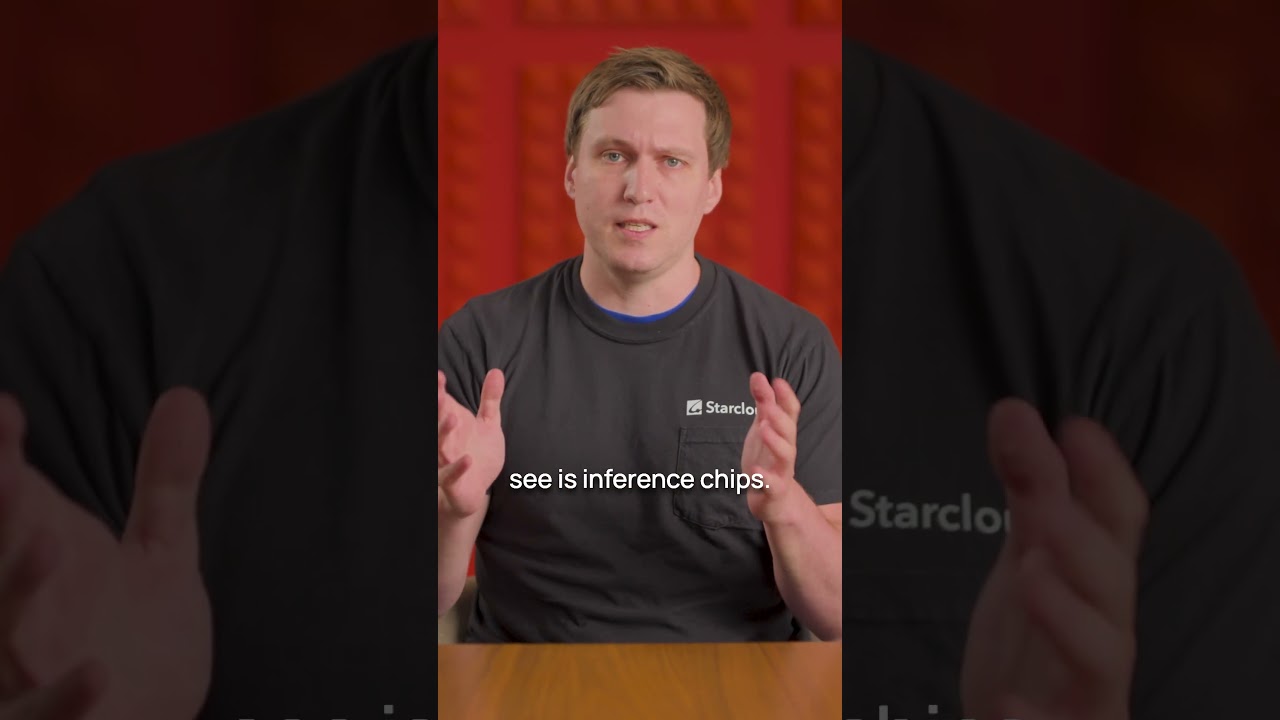
Y Combinator / StarCloud — Summer 2026 call for space hardware founders
Philip Johnston is the co-founder and CEO of StarCloud, a company building data centres in orbit. In forty-eight seconds he delivers one of the cleanest examples of second-order thinking you will hear this year: reusable rockets lower launch costs, therefore the economics of putting compute in space have broken open, therefore there will be an enormous new market for inference chips optimised for space-native constraints. Most people stopped at "reusable rockets are cool." Johnston started three steps later.
The pitch is short not because the idea is thin but because the logic chain is tight. Reusability is the input; a new class of space-qualified silicon is the output. Between those two facts lies a whole latticework of models — leverage, opportunity cost, constraint-based design, and a market-timing instinct that deserves its own entry. What follows is a pass through that structure.
This is also a video about who gets to see an opportunity first. Johnston spent time inside the aerospace and chip worlds before founding StarCloud. His insight is not a macro bet on space; it is a micro observation that the people most qualified to build space-native chips are sitting at SpaceX and Nvidia right now, and they are not yet founders. YC is calling them home.
Second-order thinking gets its clearest illustration here in years. Reusable rockets are a first-order fact. Every analyst has priced that in. The second-order consequence — that dramatically cheaper access to orbit creates a vast new compute market whose physics differ from terrestrial compute — is still largely unpriced by startup formation. Johnston is not pitching a rocket company; he is pitching the picks-and-shovels play downstream of rocket commoditisation. That is the model in action: skip the obvious beneficiary and ask what the beneficiary's beneficiary needs.
Leverage appears as a structural fact about this market. Once a chip is designed for space-native constraints — mass, thermal tolerance, radiation hardening — it becomes the only viable option for every inference workload running in orbit. There are no incumbents yet. The leverage ratio of first-mover advantage in a market with high switching costs and physical constraints is extraordinary. Johnston does not use the word; he does not need to.
The third reinforced model is opportunity cost, applied in reverse. If you are a chip designer at SpaceX or Nvidia right now, every day you are not building a space-native inference chip is a day the window narrows. Johnston closes by naming them directly. The specificity is deliberate: this is not a generic call for hardware founders, it is a recruitment pitch aimed at the precise population of people who hold the relevant tacit knowledge.
The dominant frame in chip design for the past forty years has been Moore's Law as universal progress measure — more transistors, more performance, lower power, repeat. That frame quietly assumes a single operating environment: terrestrial. Johnston's pitch is a quiet demolition of that assumption. In space, the performance envelope is not defined by clock speed or power consumption. It is defined by mass, by thermal behaviour in vacuum, and by resistance to ionising radiation. A chip that dominates terrestrial benchmarks may be useless at 400 km altitude.
Similarly, the familiar heuristic that the best technology always wins gets bent here. In space, good enough plus radiation-tolerant beats state-of-the-art plus radiation-fragile. The optimisation target is orthogonal to what the chip industry has been optimising for. This is a domain where Goodhart's Law threatens the incumbents: they have been so busy winning the metric that the market optimises for that they may miss the metric that space demands.
Finally, the tidy model of market-sizing from demand data breaks down when the market does not yet exist at scale. Johnston is not estimating today's satellite compute market; he is betting that reusable rockets will create a market that dwarfs any current figures. That is founder thinking, not analyst thinking. The latticework needs a model for that kind of bet.
Johnston's pitch introduces what deserves to be called triple-constraint inversion — the idea that designing for the most hostile operating environment produces chips robust enough to dominate multiple downstream markets. A chip built for radiation tolerance, thermal stability, and mass efficiency in orbit will be resilient in data centres during power fluctuations, reliable in edge deployments in extreme climates, and preferable in any context where uptime is paramount. Designing for the hardest case is not a cost; it is a platform strategy.
Alongside that sits founder-market specificity — the principle that in markets whose primary constraint is tacit engineering knowledge, the optimal founder is not a generalist entrepreneur but a domain-insider who has already spent years accumulating the relevant know-how. Johnston is not asking for a smart generalist to figure out space compute from scratch. He is asking SpaceX and Nvidia engineers to translate existing expertise into a new company. The value is the knowledge transfer, not the entrepreneurial bravado.
The third new model is what might be called picks-and-shovels compounding — once launch costs fall, the market for space-native hardware grows, which funds R&D on better space-native hardware, which enables more sophisticated orbital workloads, which further expands the market. The shovel business compounds when the gold rush scales. This is distinct from simple first-mover advantage; it is a reinforcing loop that only starts running when the enabling infrastructure (cheap access to orbit) reaches a threshold. Johnston is arguing that threshold is now.
Munger's case for the latticework was always about anti-fragility across disciplines. Johnston's pitch is useful precisely because it imports a physics argument — orbital operating conditions — into the model of market formation. When the environment changes, the optimal product changes, and the optimal founder changes. The latticework that survives is the one that can hold "the market was defined by terrestrial physics" and "now it is not" at the same time, without pretending the old model still applies.
The particular electronics in space I would like to see is inference chips. — Philip Johnston, StarCloud / YC