Ashley Hodgson · Economics & Incentives
Externality vs Externalization of Harm
An externality is a side effect that spills onto bystanders. Externalization of harm is something darker: a powerful actor strategically—often unconsciously—engineering a situation where costs land on people who have no voice in the decision at all.
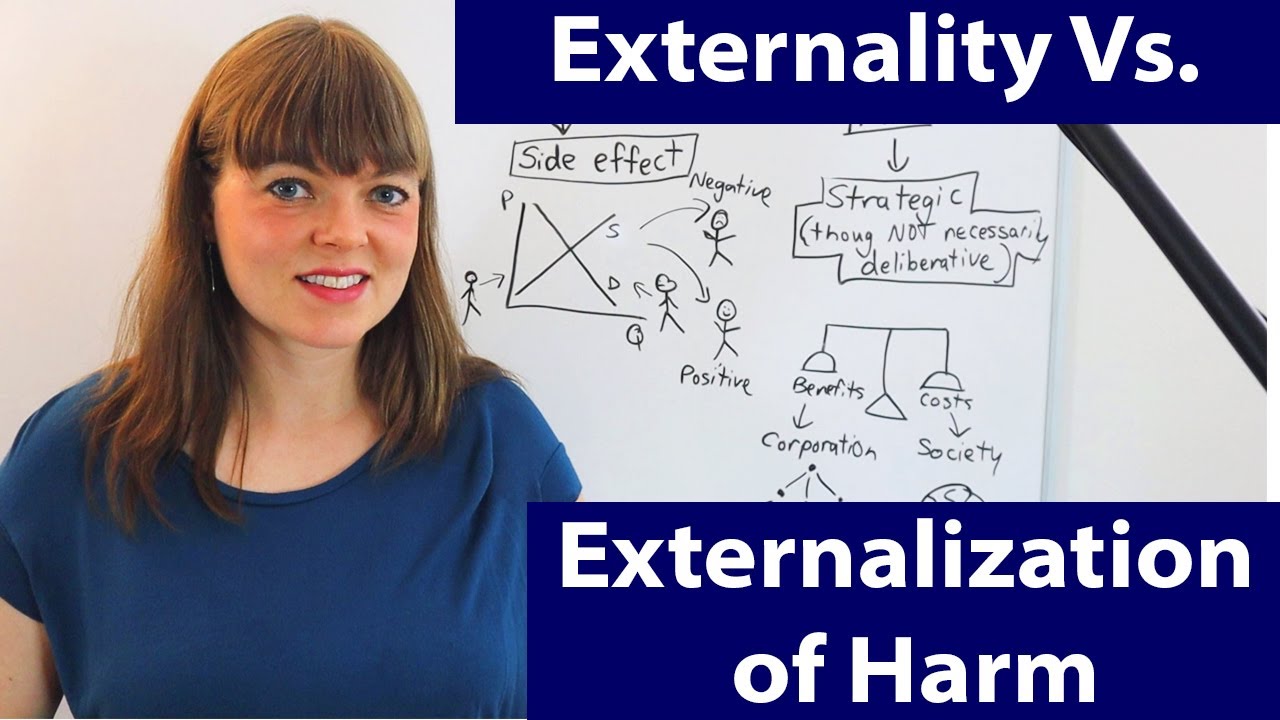
Tap a timestamp pill below to jump the video to that moment.
The problem
Two words that sound interchangeable but describe very different failure modes
Economists throw around the word “externality” constantly—it covers pollution, noise, secondhand smoke, the positive spillover of a neighbor's well-kept garden. Ashley Hodgson starts here because the term has a very specific structure that matters: a market or transaction generates a side effect that lands on someone who had no seat at the table. The suppliers and buyers involved in a market collectively set its price and volume through their decisions; the person who breathes the factory's exhaust never voted on any of it.
“The thing being imposed on somebody else is a side effect of the main event.”
The key feature of an externality, as Hodgson frames it, is that nobody is particularly aiming at the person being harmed. The actors involved aren't thinking about them; the harm is genuinely incidental. That's not a moral absolution—it still creates policy problems—but it characterizes the mechanism correctly.
Externalization of harm looks superficially similar but has a different underlying structure. The question Hodgson poses: what if the offloading of costs isn't merely incidental—what if it's the mechanism by which the actor profits? What if the reason the actor is competitive, or even solvent, is precisely that they've found a way to make society absorb costs that should rightfully appear on their own ledger?
How they solve it
Strategic cost-shifting doesn't require bad actors—it just requires asymmetric power
Hodgson's core move is to separate strategic from deliberate. When she says externalization of harm is strategic, she does not mean someone in a boardroom decided “let's dump this cost on the public.” It may be evolutionary: corporations that externalize costs grow, corporations that internalize them shrink or fail, and over time the survivors are the ones who externalize—without any individual decision-maker necessarily understanding or intending what's happening. Intent is not required for the pattern to be real.
“This does not require evil actors. It does not require intention at all.”
The whiteboard picture Hodgson draws is simple and devastating. Inside the corporation, decision-makers list the costs and benefits of a choice. The benefits flow in—to the C-suite, to shareholders, to the balance sheet. The costs, however, are borne by people outside the company: distributed across society as a tiny negative effect on a very large number of people. Those costs genuinely appear on the whiteboard—but because they aren't borne by the people making the decision, they get pushed to the side. What's left in the center of the decision-maker's field of view is pure upside.
“All of the costs are borne by people outside the company… the benefits are accrued inside.”
The distinction from a pure externality is about power and structure. In a market externality, no single actor has enough leverage to have deliberately set the outcome; the harm emerges from the aggregate of many small decisions. In externalization, there's a specific actor with enough concentrated power that their decisions materially shape the cost landscape—and that actor's incentive structure is perfectly aligned with pushing costs outward. It doesn't need to be a conspiracy. It just needs to be a sufficiently large power differential between the decision-maker and the person who absorbs the cost.
“The people over here actually are externalizing harm—it's just that they're choosing not to look in that direction.”
The policy implication is significant. If you treat externalization of harm as just a special case of externality, the standard toolkit applies: Pigouvian taxes, regulations, liability rules. But Hodgson's framing suggests those tools may be insufficient when the harm is being strategically (if not consciously) generated by actors with the political and economic power to shape the rules themselves. The correction needs to address not just the mispricing but the power asymmetry that makes the mispricing durable.
Takeaway
The quick version
- An externality is a genuine side effect: nobody in the transaction was aiming at the person harmed. The harm is incidental to the market's normal operation.
- Externalization of harm has a structural difference: the costs are offloaded onto people who had no decision-making power, while benefits concentrate in the actor who made the choice.
- Intent is not required—evolutionary selection among firms can produce systematic externalization even when no individual executive planned it.
- The power asymmetry is the key variable: individuals in a market can't meaningfully externalize because their share of the outcome is too small; concentrated actors can and do.
“The people over here actually are externalizing harm—it's just that they're choosing not to look in that direction.”— Ashley Hodgson
The distinction matters practically: diagnosing a problem correctly determines which interventions have any hope of working. A Pigouvian tax on pollution corrects a pricing failure; dismantling the power structure that keeps the price wrong requires something different.