Veritasium · Engineering History
How They Prevented The Citicorp Disaster
In 1978, a student discovered that the Citicorp skyscraper could topple in a moderate wind. What followed was a covert nighttime welding campaign—steel plates on 200 joints, all kept secret from the office workers above.
Tap a timestamp pill below to jump the video to that moment.
The problem
A structural flaw discovered after the tenants moved in
The Citicorp Center, completed in 1977, was an architectural tour-de-force: a 59-story Manhattan tower raised on four massive stilts placed at the mid-span of each side rather than at the corners, freeing the ground level for a public plaza and a church. What the tower's engineer, William LeMessurier, did not fully model during design was the behavior of the building under quartering winds—winds hitting the corners at a 45-degree angle rather than head-on.
In 1978, an architecture student called LeMessurier to ask about the unusual column placement. Working through the math to answer her question, LeMessurier discovered that the quartering-wind loads were significantly higher than the perpendicular loads the design had been checked against. Then he discovered something worse: the welded joints specified in his design had been built as cheaper bolted connections instead. Under the original welds, the building would have been marginal. Under the bolted joints actually in place, it was fatally compromised in a storm that had a roughly 1-in-16 chance of occurring in any given year.
“LeMessurier acquired emergency generators for the tuned mass damper…”
The consequence of failure wasn't just the tower itself. Skyscrapers in dense Manhattan are close enough that a collapse triggers a cascade. As one interviewee describes it: “This would have toppled, and it would have toppled into another building, which would have toppled into another building, which would have continued a horrific process.” The ultimate effects, they add, were “untold.”
“This would have toppled into another building, which would have toppled into another building…”
How they solve it
Welders by night, office workers by day—a repair kept entirely secret
LeMessurier went to Citicorp's executives and to the New York City Buildings Department rather than trying to cover up the flaw. The decision was both ethical and practical: the repair required access to structural members hidden behind finished walls throughout an occupied building, which meant construction crews had to work in complete secrecy overnight and restore the appearance of normalcy before employees arrived each morning.
The fix was direct: two 5-centimeter thick, 2-meter long steel plates were welded to both faces of each chevron beam joint, creating what one participant called “band-aids—literally, band-aids” that dramatically increased the joint's capacity. Over 200 joints needed this treatment. Engineers ranked them by criticality, starting with those on the 30th floor where the structural loads were highest, and worked outward from there.
“Each night, welders would enter the building, rip off the sheetrock… and then weld two 5-cm thick steel plates on each joint.”
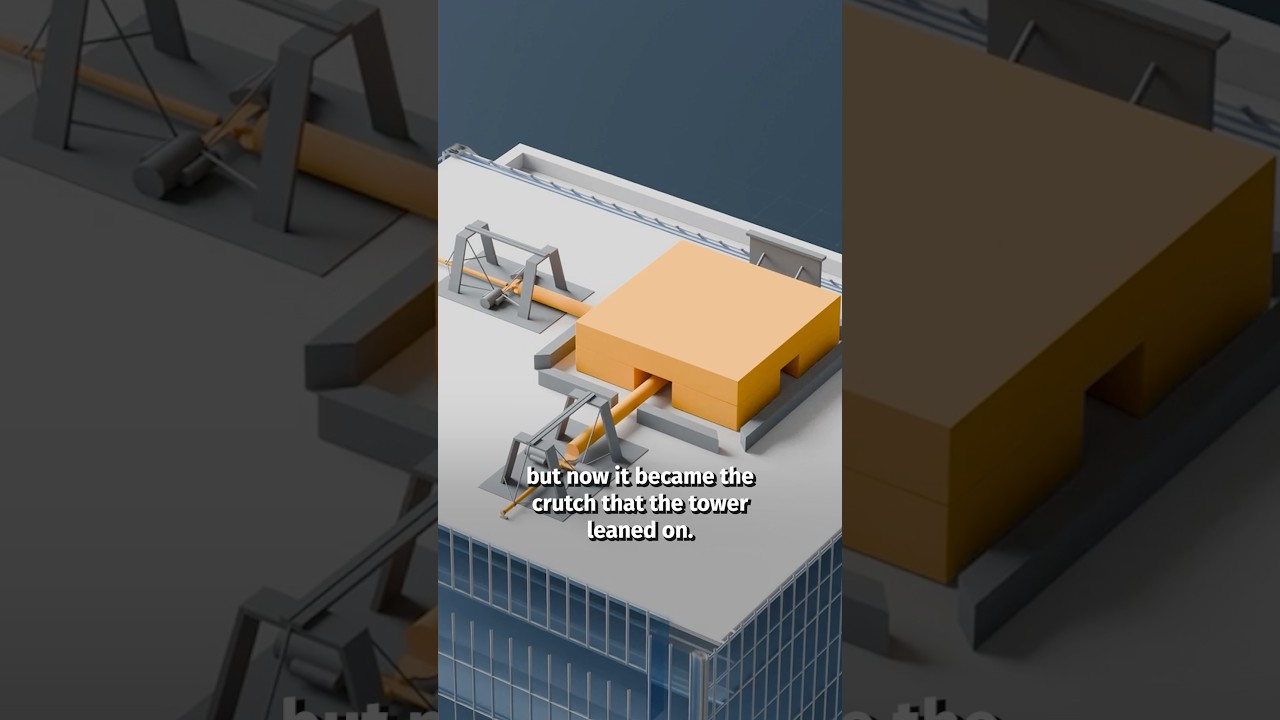
The repair was a race against the calendar. Hurricane season arrives before all 200 joints could be welded. The interim response was twofold: the building's tuned mass damper—a 400-ton concrete counterweight originally installed just to reduce occupant discomfort during high winds—was fitted with emergency generators so it could run independently of city power. And Citicorp worked with the Red Cross to design a 10-block evacuation plan for the surrounding neighborhood, just in case.
“Citicorp worked with the Red Cross to develop a 10-block evacuation plan.”
The public, and the office workers inside the building, were never told. Engineers and city officials concluded that mass panic posed more immediate danger than the structural risk itself, given that the repair was actively underway and the building was being monitored around the clock from a communications center eight blocks away via strain gauges on every critical member. The repair completed successfully before any serious storm arrived. The flaw remained entirely unknown outside of a small circle until an article by Joe Morgenstern in The New Yorker brought it to public attention in 1995.
Takeaway
The quick version
- A design flaw in the Citicorp Center's bolt connections—substituted for welded joints during construction—left a 59-story Manhattan skyscraper vulnerable to a once-in-16-years storm event.
- The engineer who discovered the flaw disclosed it rather than concealing it, setting up a covert but legitimate repair: welders working overnight on 200+ joints behind intact office walls.
- Interim safeguards during hurricane season included emergency-powered tuned mass dampers and a 10-block Red Cross evacuation plan that was never activated.
- Real-time structural monitoring from a remote comms center—strain gauges on every critical member—was the early-warning backstop throughout the repair.
“This would have toppled into another building, which would have toppled into another building, which would have continued a horrific process.”— Witness, Veritasium
The Citicorp story is remembered as a case study in engineering ethics as much as engineering repair—the flaw was caught because someone asked a simple question, and fixed because one engineer chose disclosure over self-protection.