Veritasium · Science & Technology
Is spider silk really stronger than steel?
Spider silk beats steel by almost every mechanical measure—but spiders can’t be farmed. The answer may lie in silkworms carrying borrowed spider genes.
Tap a timestamp pill below to jump the video to that moment.
The problem
A material that embarrasses steel—and can’t be made at scale
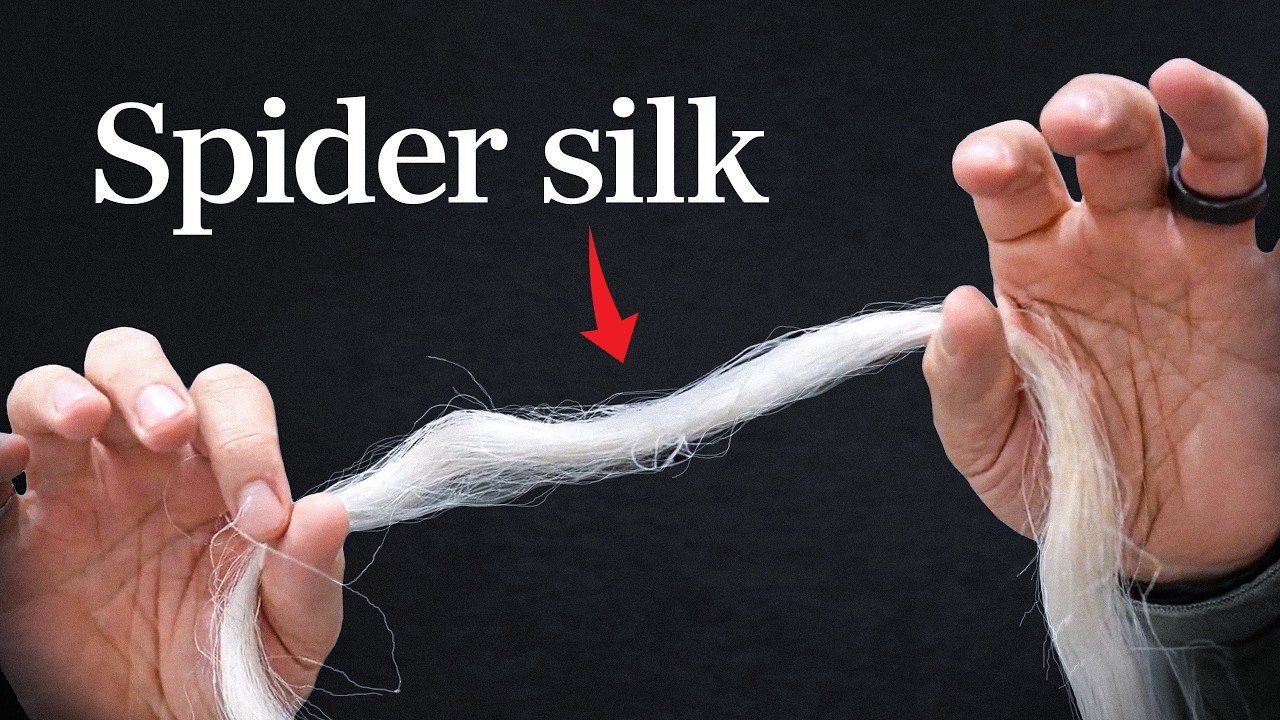
The video opens with Derek Muller hanging from a single filament of spider silk in a climbing gym. The filament looks like a wisp of nothing. It holds him. That image captures the central paradox of spider silk: it is, by tensile strength per unit weight, stronger than steel. It is tougher than Kevlar. It is simultaneously strong and elastic in a combination no synthetic material has managed to replicate. Biophysicists have calculated that a pencil-thick cable of spider silk could stop a Boeing 747 at takeoff speed.
The problem is not the material. The problem is the supplier. Spiders are territorial and cannibalistic. Put them together and they eat each other. Every attempt at silk farming has failed. The raw material for what may be the world’s most useful structural fiber sits locked inside creatures that refuse to be herded, producing only in microscopic individual quantities.
And making spider silk from scratch is harder than it looks. The proteins that form the silk—called spidroins—assemble inside a spinning duct under conditions that remain only partially understood. The process happens at room temperature, inside a living body, without the caustic solvents that the polymer industry normally requires to produce comparable fibers. The resulting structure contains crystalline beta-sheet regions that give the silk rigidity, interlocked with amorphous domains that give it stretch. Reproducing this from chemistry alone has so far eluded the field.
The molecular secret behind spider silk’s strength—how spidroins arrange themselves
“Now, the secret to spider silk’s unbelievable natural strength lies in how those building blocks are arranged. If you look inside a silk fiber, you’ll find spider silk proteins called spidroins. They’re doing it at room temperature, inside a living body, with the same basic building blocks that you use to build your hair and your skin.”
How they solve it
Putting a spider’s genes into a silkworm
The pivot is elegant: instead of farming spiders or rebuilding silk from chemistry, a Michigan biotech called Kraig BioCraft is repurposing an animal humanity has already been farming for nearly 5,000 years. Silkworms—the caterpillars of the domesticated silk moth—already have silk glands, spinning organs, and the biological infrastructure to produce fibers at scale. One moth lays 500 eggs every 30 days. The production problem is already solved. What if the silkworm could be persuaded to spin spider silk instead of its own?
The mechanism is a jumping gene called piggyBac, first identified in a cabbage looper moth. Jumping genes, or transposons, are stretches of DNA that move around the genome naturally—cut out from one location and inserted somewhere else by a dedicated enzyme. PiggyBac works by recognizing a distinctive four-letter sequence (TTAA) at both ends of the gene; the enzyme finds those sequences, cuts the whole section out, and pastes it somewhere else. Kraig’s researchers swap the middle section for spider silk genes, then inject the construct into silkworm eggs under a microscope using needles half a micron in diameter—about the width of a bacterium.
PiggyBac—nature’s cut-and-paste system used to insert spider DNA into silkworm eggs
“These are called jumping genes, or transposons. One specific one is called piggyBac, and it was first identified in a cabbage looper moth. PiggyBac is a piece of DNA with two short sequences at its ends, and it works together with an enzyme that recognizes these ends, cuts the whole piece out, and inserts it somewhere else in the genome, kind of like a natural cut and paste system. What scientists realized is that if the enzyme only looks at the two ends, then you can keep those ends the same, but change what sits in the middle, and use that to implant the DNA of your choosing.”
The catch is precision. Because piggyBac targets a four-letter sequence that appears thousands of times in the silkworm genome, the spider silk gene doesn’t always land in the silk gland—and if the instructions end up in the wrong part of the genome, the silkworm ignores them. The result is that transgenic silk is only about 6–10% spider protein. Yet even this diluted version achieves around 60% of pure spider silk’s mechanical performance. As the Kraig CEO put it: “Show me any other place in the world where you can get materials that perform at 60% the strength of spider silk that you can make cost effectively.” Last year, the company produced half a ton of the fiber.
The path to higher purity runs through CRISPR-Cas9, a more precise editing tool now being explored by Kraig and other leading labs. Unlike piggyBac, which targets a four-letter sequence with thousands of matches, a CRISPR guide matches about 20 DNA letters—specific enough to land in one exact spot. The plan is to knock out the silkworm’s own native silk gene entirely and replace it with the spider version, producing fibers that are 100% spider silk while keeping the silkworm as the manufacturing platform. AMSilk in Germany and Spiber in Japan are taking parallel routes via protein fermentation, with fibers already appearing in clothing from Goldwin and The North Face.
Takeaway
The quick version
- Spider silk outperforms steel on strength-to-weight, toughness, and elasticity—the problem has never been the material, only the supplier.
- Transgenic silkworms using the piggyBac jumping gene already produce fiber at ~60% spider silk strength; half a ton was made last year.
- CRISPR-Cas9 is the next step—replacing the silkworm’s native silk gene entirely with the spider version for purity closer to 100%.
- Downstream applications include body armor, biomedical sutures, nerve repair, and structural composites—if production scales further.
“Show me any other place in the world where you can get materials that perform at 60% the strength of spider silk that you can make cost effectively.”— Jon Rice, CEO, Kraig BioCraft Laboratories
After Derek swings from the filament—and it holds, though it cuts his fingers—the video calls out Tom Holland by name to try the same. The material works. The biomechanics of swinging from it just need a bit more Spider-Man.