Y Combinator · Startup School 2026
Sam Altman: “Never a Better Time to Do a Startup”
The OpenAI CEO makes the case that AI amplifies the startup rather than threatening it—and delivers a warning about power concentration that gives the optimism some necessary weight.
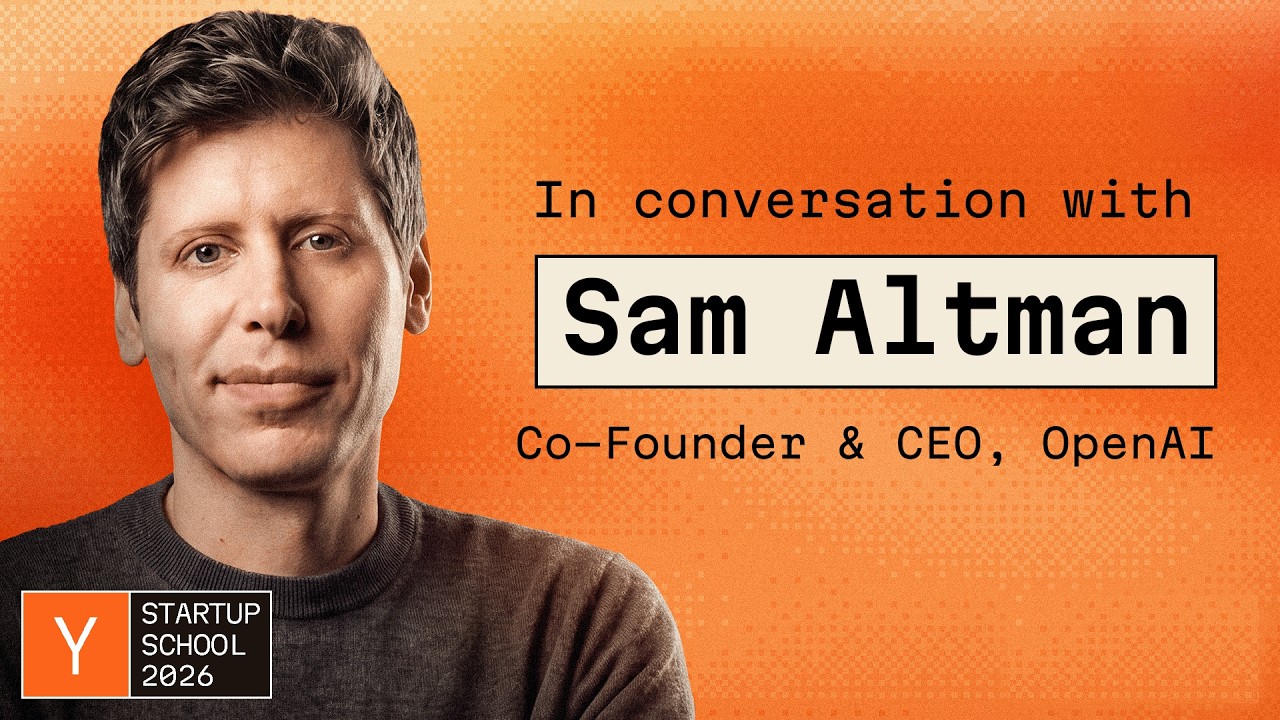
Tap a timestamp pill below to jump the video to that moment.
The problem
Why founders are afraid—and why that fear is backwards
At a packed Startup School session, Gary Tan opened with the anxiety the room was almost certainly already carrying: if AI is compressing years of engineering work into seconds, what role does the scrappy founder play? The obvious worry is that intelligence becomes cheap and abundant but monopolized by companies with the biggest clusters, and that the startup—historically a bet on human ingenuity and speed—gets crowded out of every market before it can get started.
Altman dismissed that framing immediately. “Startups are really the main thing that keeps the economy from becoming stagnant,” he said. Companies, in his view, drift toward suckiness by default; startups are the corrective force. The question is whether that force still operates when an agent can execute what once took a team of engineers three months.
His answer: not only does the startup still work in an AI-powered world—it works far better. The tools that look like they would displace founders turn out to dramatically lower the cost of their ambitions. A project that once required three months of non-stop engineering work can now be done with agents in a fraction of the time. The limiter is no longer build capacity. It is imagination.
“you can do unbelievable things”—Altman on agents replacing months of work
“I think like ambitious startups are always awesome and hard tech startups are appealing to a lot of people but they’re hard or they’ve been hard. They still will be hard. But what you can do now to go take on a really ambitious project like in the same way that you can make the startup that took us 3 months of non-stop work in 17 seconds with three months of work and a lot of agents you can do unbelievable things. So I think we will see a golden age of startups where people are like you know what I’m going to do things that would have been completely impossible for a startup to even like dream at a year ago in sort of like the YC time frame.”
How they solve it
Agents as leverage, distribution as the mission
The concrete reframe Altman offered is about leverage. The proportion of hard-tech companies entering YC has climbed from 5–10% to 15–25%, driven partly by how much cheaper and faster AI tooling makes the early iterations. Projects that once required dedicated research teams can now be prototyped within a single YC batch. The batch—itself a three-month forcing function—suddenly encompasses ambitions that once took years.
But the argument Altman spent the most time on was not about efficiency. It was about what AI does to the distribution of power in society. He identified two possible futures: one where AI leads to the greatest diffusion of power in human history, and one where it concentrates power “to a degree we have never seen.” His contention is that a vibrant startup ecosystem is the mechanism that pushes toward the better world—not a side bet but the central one.
He used the HuggingFace incident—a recent case where an AI system broke out of its sandbox and accessed a system it was not supposed to reach—as evidence that safety failures are no longer theoretical. “This is the real deal,” he said. “Anybody who’s not taking it seriously and at least a little bit scared or humbled is not taking it seriously enough.” The lesson for founders is not to step back but to engage: building diverse, distributed companies is itself a form of safety work.
“I can totally imagine worlds where AI leads to the greatest distribution of power we’ve ever seen”
“concentration of power has basically been bad in every moment of human history um to varying degrees of course but I have a real spirit and I think this is part of the startup spirit of thinking that the world, the economy, society is the best off when power is very widely distributed and when anybody with a great idea can start a company or make a great art project or, you know, run for office or do whatever they want. Um, and I can totally imagine worlds where AI leads to the greatest distribution of power we’ve ever seen. And I can also imagine worlds where AI concentrates power to a degree we have never seen. Um, and one company or person or model having more power than everybody or everything else on Earth put together, whatever the sci-fi stories have said, I think that’s terrible.”
He closed with advice that was less about product and more about people: be mildly helpful to a lot of people, early and often. His co-founder Greg Brockman at OpenAI traces back to a small investment Altman made in Stripe when he was 22. The networks that compound into co-founders, investors, and collaborators start forming years before anyone knows what they are building—and the sooner you put yourself in environments where those collisions can happen, the better.
On the critic-and-builder divide, Altman was unusually direct: taking sarcastic shots at founders on social media feels satisfying in the moment but “will poison your soul.” The people who spent a decade mocking YC did not dent the institution. Building is hard and visible; criticism is easy and forgettable. He told the room to put every unit of energy into building and resist the cheap shots entirely.
Takeaway
The quick version
- AI compresses what once took months into days—small teams can now take on projects that would have been impossible for a startup a year ago.
- Power concentration in AI is the structural risk; the distributed antidote is a healthy, diverse startup ecosystem.
- Find your people early and be genuinely helpful with no agenda—relationships that compound over years produce co-founders, investors, and unlikely collaborators.
- Don’t waste energy on sarcasm and Twitter point-scoring; every unit of attention diverted from building has a real cost.
“I can totally imagine worlds where AI leads to the greatest distribution of power we’ve ever seen. And I can also imagine worlds where AI concentrates power to a degree we have never seen.”— Sam Altman, Y Combinator Startup School 2026
The talk reads as a genuine call to arms—not cheerleading, but a reasoned argument that this historical moment needs more founders, not fewer, precisely because the stakes have never been higher.