Y Combinator · Startup School
10 Habits PhDs Must Unlearn To Build a Startup
A Y Combinator founder breaks down the ten academic instincts that quietly kill startups—and what to replace them with.
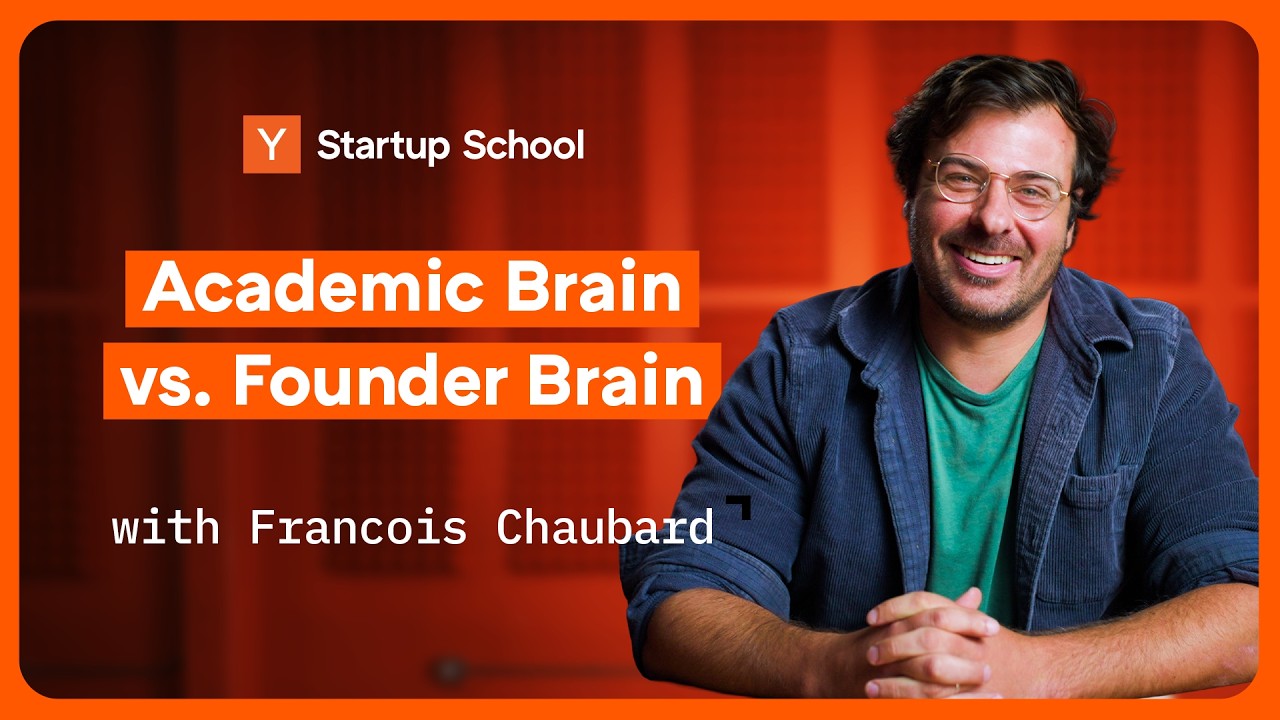
Tap a timestamp pill below to jump the video to that moment.
The problem
The same habits that earn a PhD will sink a startup
Some of the most celebrated tech companies—Google, Anthropic, Databricks—were founded by people with PhDs. That list is real but misleading. The speaker, a former researcher in Fei-Fei Li’s lab who went on to found a startup, is blunt: academic success trains you for the wrong game. The skills that get papers accepted and citations flowing are, in many cases, the exact instincts that make founders fail.
The core mismatch is about what you’re optimizing for. In a PhD program, you chase vanity metrics: grades, citation counts, conference invitations. These are legible, predictable, and controlled by other academics. The startup version of success is controlled by strangers who will vote with their credit card—or not. Paul Graham captures this cleanly: “The most damaging thing you learned in school wasn’t something from any specific class. It was learning to get good grades.”
startup. Number one, focusing on vanity metrics versus what people want. In academia, you're...
The mismatch compounds because PhD training actively rewards the opposite of founder empathy. Academics optimize for what is interesting—for mechanism, novelty, elegance. Founders must optimize for what is important to their users, even if that means shipping something they can’t fully explain and don’t fully understand. “Ship it. Empiricism is completely fine” is a heresy in a research lab and a survival skill in a startup.
How they solve it
Ten specific perspective shifts, with the receipts
The speaker’s ten-point list is not abstract career advice. It’s organized around the concrete moment where academic instinct and founder reality collide. Each habit has a name, a failure mode, and a corrected version.
The novelty instinct is one of the more counterintuitive reversals. In academia, an idea that’s been done before is dead on arrival. In startups, Joe Lonsdale’s distinction between MIT-style and Stanford-style companies illuminates the alternative. MIT-style startups are built around a patented black box that does unprecedented magic—and “rarely turn into massive companies because frankly no one really wants your blackbox.” Stanford-style startups start with one boring customer problem and iterate on it forever. Instacart didn’t invent grocery delivery. It was just the most disciplined executor. Lyft didn’t invent ride-hailing. Plagiarism, the speaker argues, is not only acceptable but often superior.
The validation lesson is where theory becomes personal. The speaker describes spending three months at his own company, Focal, collecting training data and building models for people-tracking in retail stores. Every retailer told them it was a critical problem. When they finally delivered the product, it told store managers that people congregate at checkout and deli counters at lunch. Would they pay? “Absolutely not,” came the answer. The same insight could have come from manually labeling a few videos. Three months of compute and ML engineering, gone.
mistake at Focal. We spent a lot of time collecting training data, training models to solve people...
Speed over perfection is the third major pivot, and it comes with a stark historical example. When Michael Stonebraker built Ingres, a technically superior database to Larry Ellison’s early SQL implementation, Ellison wasn’t impressed. His reported response: “Ingres might be better than SQL. I don’t care. SQL is going to win.” Ellison pushed SQL to market faster. He won. The speaker frames Jeff Bezos’s “70% rule”—most decisions should be made with roughly 70% of the information you wish you had—as the corrected instinct. Academics hate this. For them, 70% confidence means rejection. For founders, waiting for 100% means your competitor already shipped.
Jeff Bezos famously said that most decisions should probably be made with somewhere around 70% of...
The remaining habits follow the same logic: finish lines don’t exist in startups the way submission deadlines do, so the academic habit of working in parallel bursts across five ideas “smears the peanut butter too thin.” Customer empathy requires leaving the office, not surveying investors, who the speaker pointedly notes “have no clue what is going to be a great product.” And the tenth habit is the most culturally fraught: academics love demonstrating intelligence. Founders need to demonstrate curiosity about other people’s problems. As Dale Carnegie wrote, you can make more friends in two months by becoming interested in others than in two years trying to get others interested in you.
Takeaway
The quick version
- Optimize for what users will pay for, not what is academically interesting or novel—plagiarism is a valid strategy in business.
- Validate before building: a conversation with ten potential customers is worth three months of engineering on the wrong product.
- Ship at 70% confidence—speed beats perfect information every time a competitor is in the same market.
- The founder job is sales, hiring, and empathy, not research—abstracting yourself from customers means you can’t build what they actually want.
“Get out of your office, get on a flight, and go meet with your users where they live and work. Validate your assumptions. Will people actually pay you for this? Because that is exactly what your competition is doing.”— Y Combinator, Startup School
The intelligence is already there. The question the speaker leaves hanging is about will: whether you can sit across from a stranger, ask if they’d pay for your idea, hear “no,” and iterate anyway.